

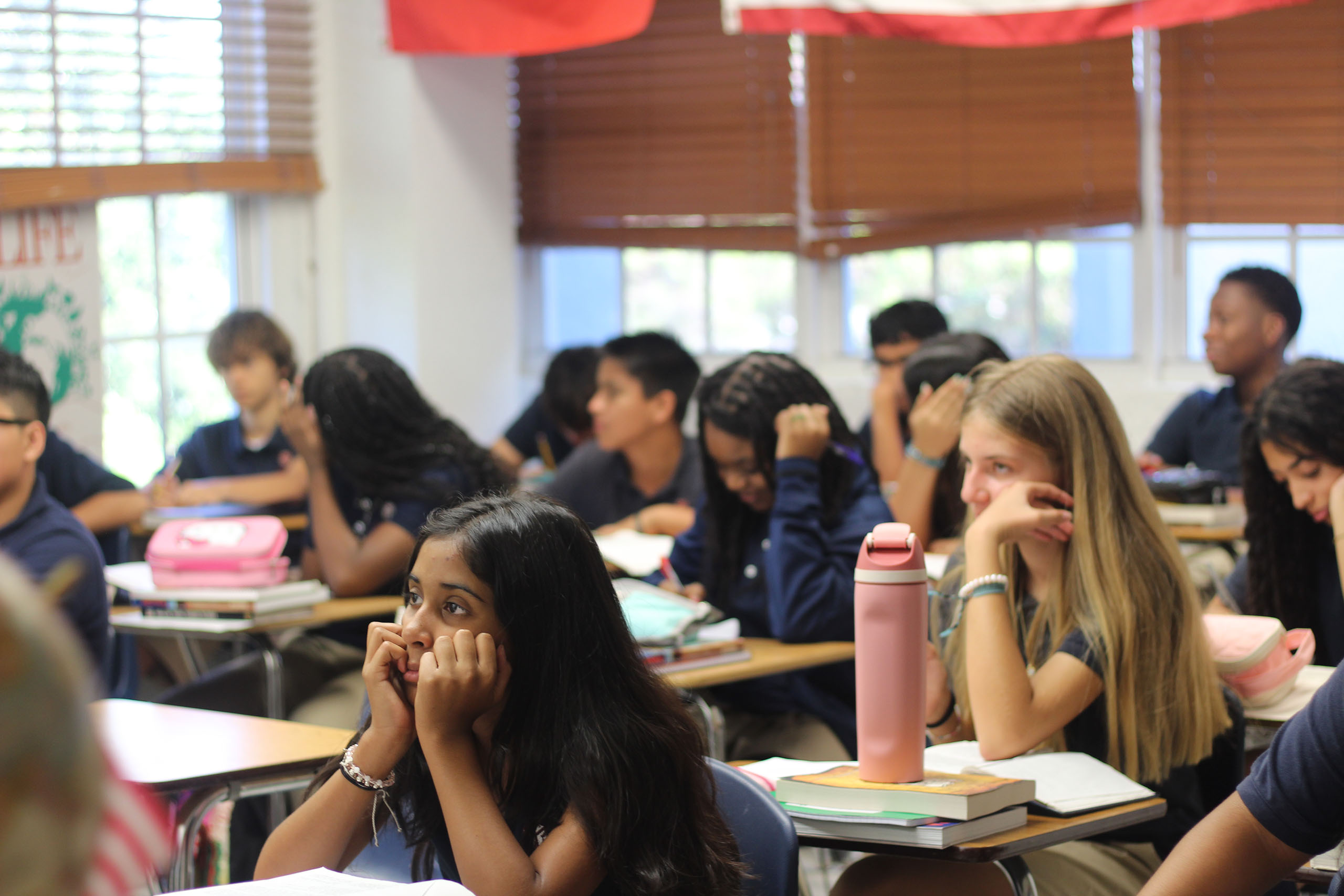
Middle School students are challenged to build a strong foundation in preparation for their high school years. They not only are equipped through knowledge and interaction, but are also encouraged to live out and put into practice what they learn through service, the arts, athletics, and other opportunities. They understand that their ultimate role is to make a difference in their world for Christ.
Middle School Curriculum
Our distinctively Christian curriculum will prepare our students to succeed in essential academic areas, emphasizing phonics, reading, listening, writing skills, mathematics, language arts, spelling, science, social studies, and Bible. Our extra curricular activities include computers, music, Spanish, physical education, art, and the Academy of the Arts.
6th Grade Course
Our sixth grade students discover how various biblical figures strove to win the race that God set for them. The lessons present an overview of New Testament doctrine, including the past, present, and future work of Christ. This study explores doctrines and themes primarily from the New Testament, including, the importance of God’s Word, the nature of sin and temptation, the character of Jesus Christ, the work of the Holy Spirit, and an introduction to eschatology in Revelation. They also learn from Hebrews of the great cloud of witnesses, those whose lives of faithful obedience encourage our enduring Christlikeness. With the Bible as our source for truth and the Spirit as our guide, believers can identify the schemes of the wicked one, access the help available to them, and look forward with hope to their future with Christ in heaven. Students are presented with opportunities to discuss practical applications and be encouraged to magnify God in all that they do and say. The Scripture memory program offers an additional avenue of learning to deepen the educational experience.
Math in sixth grade includes an abundance of practice problems and review exercises to help each student master important arithmetic skills and concepts. Almost daily story problems and frequent problem-solving strategies are featured, providing practical application for real-life situations. This course takes students from the known to the unknown as they study fractions, decimals, proportions, percents, prime factoring, algebraic equations, measurement, basic geometry, and beginning banking.
Our five-day systematic approach to spelling integrates word analysis and vocabulary, word study strategies, writing, and integration of biblical worldview. The word lists include pattern words, high-frequency words, and challenge words. Each lessons is developed to meet national language arts standards, current educational philosophy, and best practices.
The sixth grader should be constantly guided to see how grammar applies to his writing and speaking. Grammar class gives a thorough, systematic presentation of grammar, composition, and mechanics in a clear and appealing manner. Both the student and the teacher will appreciate the explanations and demonstrations of the writing process. Students who use this program are not “afraid of composition.” In Creative Writing class students are helped to think and to convey their thoughts more clearly, critically, and creatively.
Sixth graders enjoy reading exciting selections about animals of all kinds, patriots from America’s past, and Christians in foreign lands. They read from a delightful collection of stories and poems that features several well-known authors and introduces students to a variety of interesting characters. Students read a biographical novel and a Christian fiction novel and use them when writing language book reports. Two speed and comprehension readers contain challenging and interesting selections. Sixth graders develop a wider range of comprehension skills by answering comprehension questions based on stated facts, implications, and general reasoning.
Middle School Life Science, Physical Science, and Earth Science are in-depth studies into the specific areas of these sciences that include hands-on learning activities and which inspire students to want to know more and through which a biblical worldview is shaped in the mind and heart of each student. Critical thinking skills are developed through scientific inquiry and investigation, while students learn the language and process of science. Our students learn documentation of their lab experiences and other critical thinking activities. Individual and group scientific inquiry and investigation is emphasized, using a hands–on approach to learning.
New World History and Geography offers a Christian perspective on the history and geography of North and South America. It includes a chapter on Canada and a chapter on the recent events in the United States and around the world. Important geographical facts and historical documents are given special attention throughout the year. By reading special-feature articles throughout the year, students learn about the lives and contributions of great missionaries and other well-known Christian leaders.
Technology, Visual Arts, Spanish, Music, and Physical Education.
7th Grade Course
Like a roadmap, “Route 66” provides middle school students with a big picture view of God’s Word. Throughout the course, students in our seventh grade can see how God uses imperfect men and women to reflect His majesty to the world. Our students are guided to identify primary biblical themes, key events, important people, basic doctrines, and biblical principles—always highlighting the gospel of grace. As students are challenged to think about and personalize what they learn, they begin to reflect God in new ways.
This class is an intermediate Mathematics which gives a strong review of all arithmetic concepts with practical application to daily life. With solid skills in arithmetic, students have the confidence to advance to other branches of mathematics. Instruction in plane and solid geometry, probability and statistics, and algebra, provides the foundation students need to enjoy success in future mathematics courses. Practice and review problems in each lesson give sufficient opportunity for students to develop and maintain their skills while learning to work quickly and accurately. Word problems and problemsolving strategies throughout each lesson ensure that students can apply their mathematical skills to everyday situations and encourage students to connect varying types of mathematical knowledge. Fast Fact opportunities allow for further expansion of the concepts covered.
The application of spelling rules to lists of challenging words and the utilization of an expanded vocabulary is emphasized in this course. All of the spelling words are practical, and many are words that are frequently misspelled. A majority of the vocabulary words are taken from the stories in their Literature class. The goals of poetry recitation and memorization are an enjoyment and appreciation of poetic beauty and excellence.
The purpose of this course is to emphasize the orderly structure of our language and to train students to use the English language effectively. The Christian perspective of this class promotes standards of correct grammar and usage, equipping students with the tools they need to become effective communicators in both speaking and writing. Our seventh grade students learn to recognize the different parts of speech, fit these parts of speech together to form sentences, join sentences together to make paragraphs, and organize paragraphs into compositions. They will also learn to develop complete and orderly thoughts and to communicate those thoughts clearly and concisely, so that they can use God’s gift of language effectively.
The 7th grade Literature class features stories and poems that help students increase their understanding of the world, man, and God from a Christian perspective. Students gain exposure to people of different ages, nationalities, races, cultures, and economic levels to develop a better understanding of people’s motives and feelings and to recognize the consequences of particular actions. Students also become familiar with classics such as A Christmas Carol, Robinson Crusoe, Don Quixote, and Of Plymouth Plantation.
Middle School Life Science, Physical Science, and Earth Science are in-depth studies into the specific areas of these sciences that include hands-on learning activities and which inspire students to want to know more and through which a biblical worldview is shaped in the mind and heart of each student. Critical thinking skills are developed through scientific inquiry and investigation, while students learn the language and process of science. Our students learn documentation of their lab experiences and other critical thinking activities. Individual and group scientific inquiry and investigation is emphasized, using a hands–on approach to learning.
The seventh grade history course is a study on the “History of the World”. It is designed to give students a better understanding and a working knowledge of the geography of the Eastern Hemisphere. The interesting content of the class and its many illustrations, maps, and photographs invite students to explore the past and learn about the people behind the events of world history. The goal of the lessons is threefold: first, to show God’s hand in the history of the world; second, to emphasize the role of individuals in history; and third, to teach the many lessons that can be learned from history. Above all, the class emphasizes the providence of God in the actions of men. It provides students with heroes to emulate and goals to fulfill by focusing on the individuals whose character, initiative, and hard work have made a positive impact on world history.
Technology, Visual Arts, Spanish, Music, and Physical Education.
8th Grade Course
The middle school course, “Wise Up” encourages eighth grade students to study the wisdom of God in Proverbs, allowing Him to shape their lives into the image of His Son, Jesus Christ. In middle school, young people face more and more decisions on their own. Soon they find that their new freedoms are followed by greater responsibility and higher expectations. The Spirit-driven application of God’s truth transforms people to live like Jesus. The Book of Proverbs provides both significant theological and practical instructions to help believers reflect God’s character.
The Pre-Algebra class presents a brief yet complete review of arithmetic with applications to daily life. Once grounded in arithmetic, students can advance to other branches of mathematics. The topics of geometry, algebra, probability, statistics, and radicals are expanded, and trigonometry and systems of equations are introduced. These topics provide the foundation students need to enjoy success in future mathematics courses. Practice and review problems in each lesson give sufficient opportunity for students to develop and maintain their skills while learning to work quickly and accurately. Word problems and problem-solving strategies throughout the text ensure that students can apply their mathematical skills to everyday situations and encourage students to connect varying types of mathematical knowledge.
This part of the class emphasizes using an expanded vocabulary and applying spelling rules when analyzing challenging words. The goals of poetry memorization and recitation are an enjoyment and appreciation of poetic beauty and excellence.
The ability to express one’s ideas creatively as well as correctly and the ability to comprehend and interpret the written word skillfully, are built upon the elements which are included in eighth grade English. The class builds upon the skills learned in earlier grammar studies providing foundational practice of proper grammar and developing the basic composition skills used in outlining, summarizing, describing, researching, and creative writing. Students are also introduced to new grammar rules and new writing techniques that will allow them to expand their writing skills.
Through a variety of literary selections, our students are taught Christian character traits such as compassion, courage, and sacrifice, while also gaining exposure to people of different ages, nationalities, races, cultures, and economic levels. Many of the selections read were written by famous authors and are well-known classics that are an important part of a student’s education. They feature excerpts from classics such as “A Tale of Two Cities”, “The Jungle Book”, “Ben Hur”, “The Hiding Place”, and “The Legend of Sleepy Hollow”.
Middle School Life Science, Physical Science, and Earth Science are in-depth studies into the specific areas of these sciences that include hands-on learning activities and which inspire students to want to know more and through which a biblical worldview is shaped in the mind and heart of each student. Critical thinking skills are developed through scientific inquiry and investigation, while students learn the language and process of science. Our students learn documentation of their lab experiences and other critical thinking activities. Individual and group scientific inquiry and investigation is emphasized, using a hands–on approach to learning.
The eighth grade history class presents American history from a Biblical perspective: God exalts nations and determines their course in human history. The text promotes the Bible as the center of God’s plan. History is the story of individuals to whom God has given the responsibility to make choices. Unlike secular history textbooks which suggest that material things—economic conditions, geography, political circumstances, or genetics— are the main causes in history, our history class uses biographical accounts to illustrate that history traces God’s working through people to accomplish His will. Students also study the geography of the Western Hemisphere and federal, state, and local government as part of this course. Knowledge of and familiarity with local offices and officials will encourage students to use the gift of political expression which is so easily taken for granted in America.
Technology, Visual Arts, Spanish, Music, and Physical Education.