

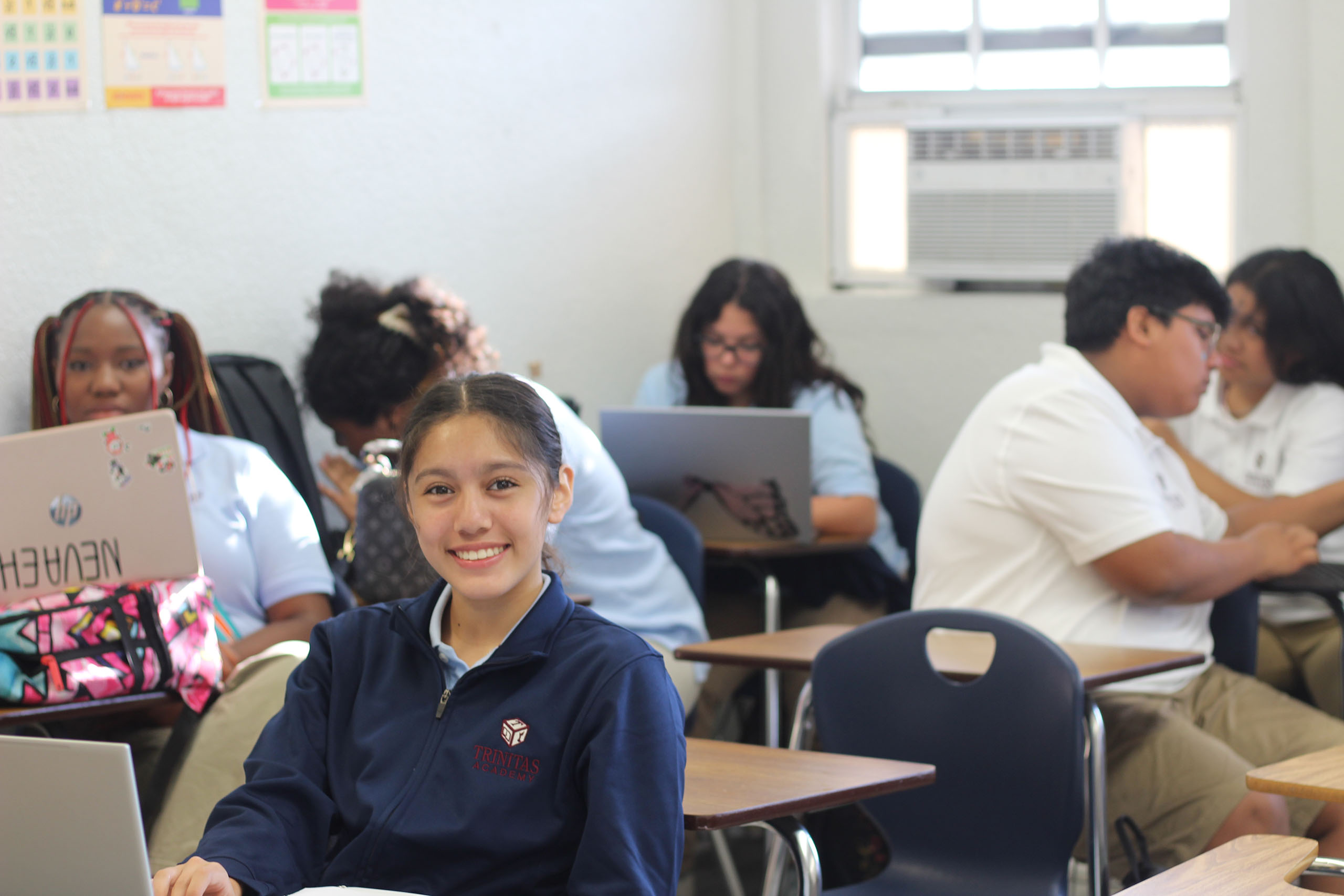
Trinitas Academy teaches from a Christian curriculum that offers a comprehensive and academically rigorous course of study. The high school program includes a broad range of subjects, emphasizing both academic excellence and Biblical values. Below is a detailed description of the high school courses included in the high school curriculum.
High School Curriculum
All subjects are taught from a Christian worldview, emphasizing biblical principles and character development. A challenging academic program that is designed to prepare students for higher education and careers The curriculum offers a balanced mix of core subjects, electives, and practical skills courses, ensuring a well-rounded education
Bible
This course engages head, heart, and hands—encouraging students to see their place in God’s story and apply biblical truth in relationships.
A Christian apologetics handbook that builds on Foundations by exploring foundational beliefs of the Christian worldview.
A comprehensive study of the world’s dominant non-Christian worldviews, contrasted with Christianity.
Equips students to thoughtfully engage key social issues and cultural arenas through a Christian worldview lens.
English
Focuses on grammar, composition, vocabulary, and literature. Students refine their writing skills by learning to compose essays and reports, while also reading and analyzing classic and modern literature.
Builds on the foundations of English 9, with an emphasis on more advanced writing techniques, including research papers and literary analysis. Students read works from diverse literary genres and learn to recognize literary devices.
Includes a deeper dive into American literature, with an emphasis on writing clear and well-organized essays. Grammar and vocabulary are also reinforced.
Senior-level English typically focuses on British literature, essay writing, and preparation for college-level writing. Students refine their writing, focusing on structure, style, and critical thinking.
Mathematics
Introduces basic algebra concepts such as solving equations, working with polynomials, and understanding functions and graphing.
Focuses on geometric principles like angles, areas, volumes, and proofs. Students learn about the properties of shapes, theorems, and their applications in real-world contexts.
Builds upon Algebra 1, delving deeper into quadratic equations, rational expressions, and logarithms. It includes problem-solving techniques and practical applications.
Prepares students for calculus by covering advanced algebraic concepts, functions, graphing, sequences, and series.
Offers a study of trigonometric functions, right triangle relationships, and the unit circle, preparing students for higher-level math courses.
For advanced students, the calculus course covers derivatives, integrals, and limits, focusing on practical applications in fields such as physics and engineering.
Science
Introduces foundational concepts in physics and chemistry, covering topics like motion, energy, matter, and basic chemical reactions.
Explores living organisms, their structure, functions, and interactions. Students study cell biology, genetics, ecology, and human anatomy.
Delves into the properties of matter, chemical reactions, atomic structure, and the periodic table. Laboratory experiments are often included to give students hands-on learning.
Introduces classical mechanics, forces, energy, waves, electricity, and magnetism. The course may include lab work and real-world applications of physical principles.
Advanced courses may include topics like environmental science, genetics, and the study of ecosystems, often with a Christian perspective on creation.
History and Social Studies
A comprehensive study of world history from ancient times to the modern era. The course covers major civilizations, events, and themes in world history, always presenting a Christian worldview. It focuses on physical and political geography, studying maps, landforms, climate, and how geography shapes cultures and civilizations.
Focuses on the history of the United States, from its founding to the present day, with an emphasis on key events, figures, and the development of American government and society.
Shows the firm Christian foundation that the United States was founded upon through a detailed presentation of the Constitution and Bill of Rights. Students see the emphasis on limited government that was intended by the Founding Fathers. As the course clearly displays the 3 branches of government along with the responsibilities that citizens have to the government.
This high school course explores the history of the Christian Church from its origins in the first century through its global development, examining key events such as the early councils, the Great Schism, the Protestant Reformation, and modern movements. Students analyze primary and secondary sources to understand theological developments, cultural impacts, and the Church’s role in shaping societies across different eras and regions. The course encourages critical thinking by comparing diverse Christian traditions and reflecting on how historical context influenced beliefs and practices.
Electives
Our progressive Spanish curriculum starts with basic vocabulary and grammar in Spanish 1 and advances to more complex sentence structures, verb tenses, and conversation in later levels.
Focuses on the development of artistic skills, including drawing, painting, and design. Students explore color theory, shading, and various artistic mediums throughout their high school experience.
Focuses in music theory, music history, and choir. Students learn to read music, understand musical notation, and appreciate different musical genres throughout their high school experience.
Introduces students to theater and performance, covering the basics of acting, stage presence, and producing live performances.
Covers topics related to physical, mental, and social well-being, including nutrition, exercise, mental health, and human development. Promotes physical fitness through exercise routines, sports activities, and discussions on the importance of maintaining a healthy lifestyle.
Equips students with essential personal and business finance skills, including budgeting, banking, credit, investing, and financial decision-making.
Develops students’ proficiency in Microsoft Office applications with a focus on Excel for data organization, analysis, budgeting, and professional reporting.
Introduces students to the basics of running a business, including marketing, finance, and management.
Teaches students how to collect, interpret, and visualize data using industry-relevant tools and techniques to support informed decision-making.
Teaches students about basic computer operations, programming, and internet safety.
Focuses on public speeches and presentation skills, helping students to develop confidence and clarity in communication.
Teaches essential life skills such as cooking, budgeting, sewing, and other practical household tasks.
Introduces the basic principles of economics, including supply and demand, market systems, and economic decision-making.
Focuses on managing home life, understanding family relationships, and preparing students for future life responsibilities.
Conclusion
Trinitas Academy’s high school curriculum provides a rigorous and holistic approach to education, blending academic excellence with Biblical principles. It offers a wide variety of subjects designed to equip students with both the knowledge and the character needed for success in college, careers, and life. Whether the student is interested in core subjects like mathematics and science, or in electives that explore the arts, foreign languages, and practical skills, our school offers a comprehensive and Christian-centered educational experience.